While more fallen WWI soldiers are being identified, what’s on their headstones can be surprising
Résumé détaillé
In northern France, the story of Australian troops who died during World War I is still being written in stone.
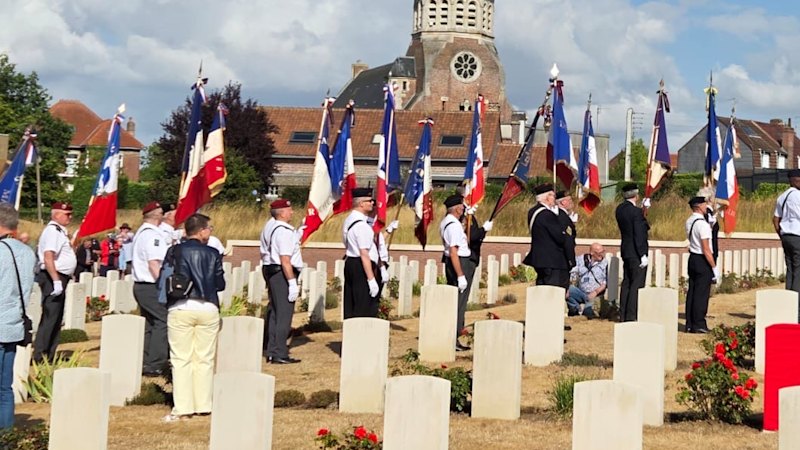
On a summer’s afternoon at Pheasant Wood Military Cemetery in northern France, I am suddenly taken aback to find life imitating art among the serried ranks of identical white headstones.
The sun’s shining down/On green fields of FranceWarm wind blows gently/The red poppies dance.
I’m startled into tears that Bogle’s words have become a part of our dialogue with the dead: they’re no longer simply poetry, they’re history.
And history has been written, revised and rewritten in this place. Northern France is cemetery country, where the parades of soldiers’ graves are as much a part of the landscape as the oak and beech trees, and the fields of barley and beet. Between 1914 and 1918, more than 530,000 British and Commonwealth servicepeople lost their lives in France. Whatever else they did in their lives they remain military personnel in death, like NSW-born labourer Craigie.
After the war, their remains were collected from their burial sites and reinterred in about 1200 graveyards created and maintained by the newly constituted Commonwealth War Graves Commission (CWGC). Those who could not be identified are remembered on grand and grim monuments still weighted with impossible sadness.
Pheasant Wood is a martial anomaly: a First World War cemetery that did not open until in 2010. It’s the newest CWGC cemetery, the first for five decades. As such, this historic farmer’s field on the edge of the village of Fromelles – and this Portland stone marker with its quatrain plucked from a song – invites reflection on the very nature and practice of commemoration, and what it is that we remember on days such as Remembrance Day. Because the story of these burial grounds is heart-tearing, and redolent with the values of age that has passed.
Indeed, I’m almost surprised that the folk singer’s lyrics were allowed on the headstone, as strict regulations have governed the wording on CWGC monuments since the end of the First World War – rules that are supposed to ensure there are no…
In 1921…
Wha…
Début de l'article, extrait de The Sydney Morning Herald. Pour lire la suite, ouvrez l'article chez le média.
MarketNews présente le titre et le résumé publiés par le média. L'article complet se lit sur le site de l'éditeur. (www.smh.com.au)