Newly Discovered Monkey Pops Up in Camera Trap Footage
ملخص مفصل
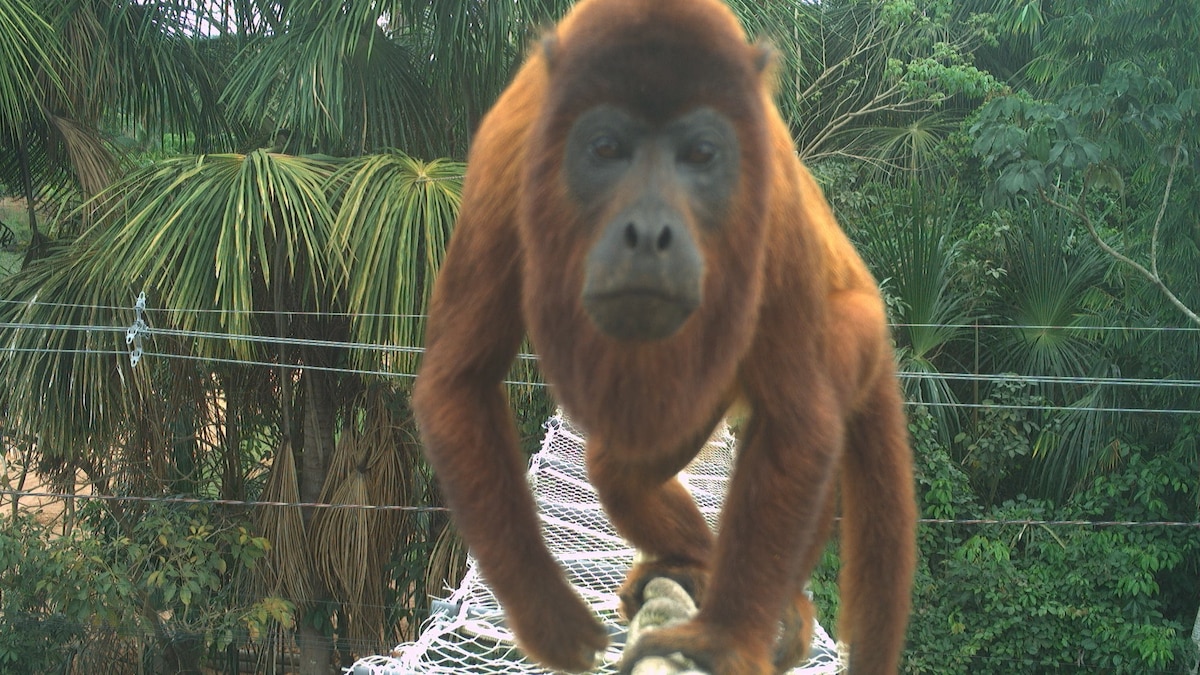
Scientists spotted Alouatta matogrossensis, a new species of howler monkey, while watching videos of animals scrambling across a canopy bridge in Brazil.
Scientists spotted Alouatta matogrossensis, a new species of howler monkey, while watching videos of animals scrambling across a canopy bridge in Brazil.
It’s a common storyline in conservation—a new species is discovered, and before there’s time to get out the Latin dictionary for naming, scientists realize the animals are already imperiled. Less common: To discover a new threatened species and find out it’s already being protected by an inspiring effort.
That’s what happened in the case of one of the world’s newest howler monkeys, Alouatta matogrossensis. Before an international team of scientists published their findings announcing the new South American species in Communications Biology in October, they reached out to Projeto Reconecta, an initiative that aims to construct numerous rope bridges to span Brazil’s roadways. These crossings act as safe passage for animals in the rainforest canopy, stitching together the tattered fabric of a once pristine ecosystem.
Among thousands of camera-trap photos from the bridges of wildlife using the crossings—including capuchins, marmosets, and titi monkeys—the researchers spotted the new matogrossensis. “We were all amazed that we were providing safe crossing opportunities for a new monkey species,” says Fernanda Abra, a road ecologist and National Geographic Explorer who leads Reconecta.
Those images were “super important,” says study co-author Romina Batista, an evolutionary biologist at the National Institute of Amazonian Research, “knowing that there was a project in that region helping these animals, keeping their gene flow across the fragmented areas. That has a huge impact on maintaining this brand-new species that we just described.”
Howlers are among the largest primates in the Western Hemisphere, found throughout Central and South America, and known for their extremely loud 100-plus decibel calls.
Matogrossensis are found in the Brazilian state Mato Grosso (hence the name), in the southern Amazon Rainforest.
مطلع المقال، مقتطف من National Geographic. لقراءة المقال كاملًا، افتحه على موقع الناشر.
يعرض MarketNews العنوان والملخص كما نشرتهما الوسيلة الإعلامية. المقال الكامل متوفر على موقع الناشر. (www.nationalgeographic.com)