Robotic sailors take on Antarctica’s winter storms
ملخص مفصل
South African researchers have joined an international mission deploying autonomous Saildrones to brave harsh Antarctic winter storms and measure how the…
The Southern Ocean, which encircles Antarctica, may be rough and remote, but its influence on the global climate is immense. It absorbs vast quantities of carbon dioxide and excess heat trapped in the climate system.
Yet the season when it may be hardest for scientists to understand how this happens is also the season they know least about: winter.
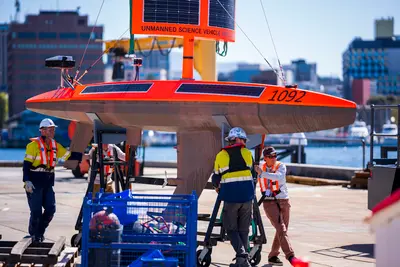
Now, an international team of researchers, including South African scientists, is sending a fleet of autonomous sailing drones into the stormy waters around Antarctica to fill that gap.
The four robotic sailing vessels will circumnavigate Antarctica, collecting data on how the Southern Ocean absorbs and releases carbon dioxide, helping scientists better quantify its role in regulating atmospheric carbon and the global carbon budget.
“Wintertime in the Southern Ocean is really poorly observed, so it's a big blind spot in our observations,” said Dr Sarah Nicholson, a lead oceanographer at the Council for Scientific and Industrial Research’s (CSIR) Southern Ocean Carbon-Climate Observatory (SOCCO), during a recent webinar about the project.
“That winter time period is hypothesised in this project to contribute to a significant portion of the uncertainty in the global ocean carbon sink. It’s really about observing in this really difficult, hard-to-reach winter period where ships aren't around.”
Ships travelling to the Southern Ocean typically do so during summer, when conditions are more manageable and research and resupply voyages to Antarctic bases take place. In winter, sea ice, powerful storms and extreme cold make observations far more difficult.
The first of four uncrewed surface vehicles, or Saildrones, was launched from Bruny Island, near Hobart in Tasmania, on 20 September. It is expected to travel more than 22 000km, measuring flux of carbon dioxide between the atmosphere and ocean, temperature, salinity, wind and other oceanographic and atmospheric conditions.
The mission forms part of a five-year international research…
مطلع المقال، مقتطف من Mail & Guardian. لقراءة المقال كاملًا، افتحه على موقع الناشر.
يعرض MarketNews العنوان والملخص كما نشرتهما الوسيلة الإعلامية. المقال الكامل متوفر على موقع الناشر. (mg.co.za)

