Same Cluster, Double the Score: RIT More Than Doubles Its IO500 Result with Next-Generation CLYSO Enterprise Storage
Detailed summary
Up to 7.3x faster on the shared-file and metadata work that keeps GPUs waiting: no new hardware, no proprietary client, open-source Ceph underneath NEW YORK, Nov. 16, 2026…
Up to 7.3x faster on the shared-file and metadata work that keeps GPUs waiting: no new hardware, no proprietary client, open-source Ceph underneath
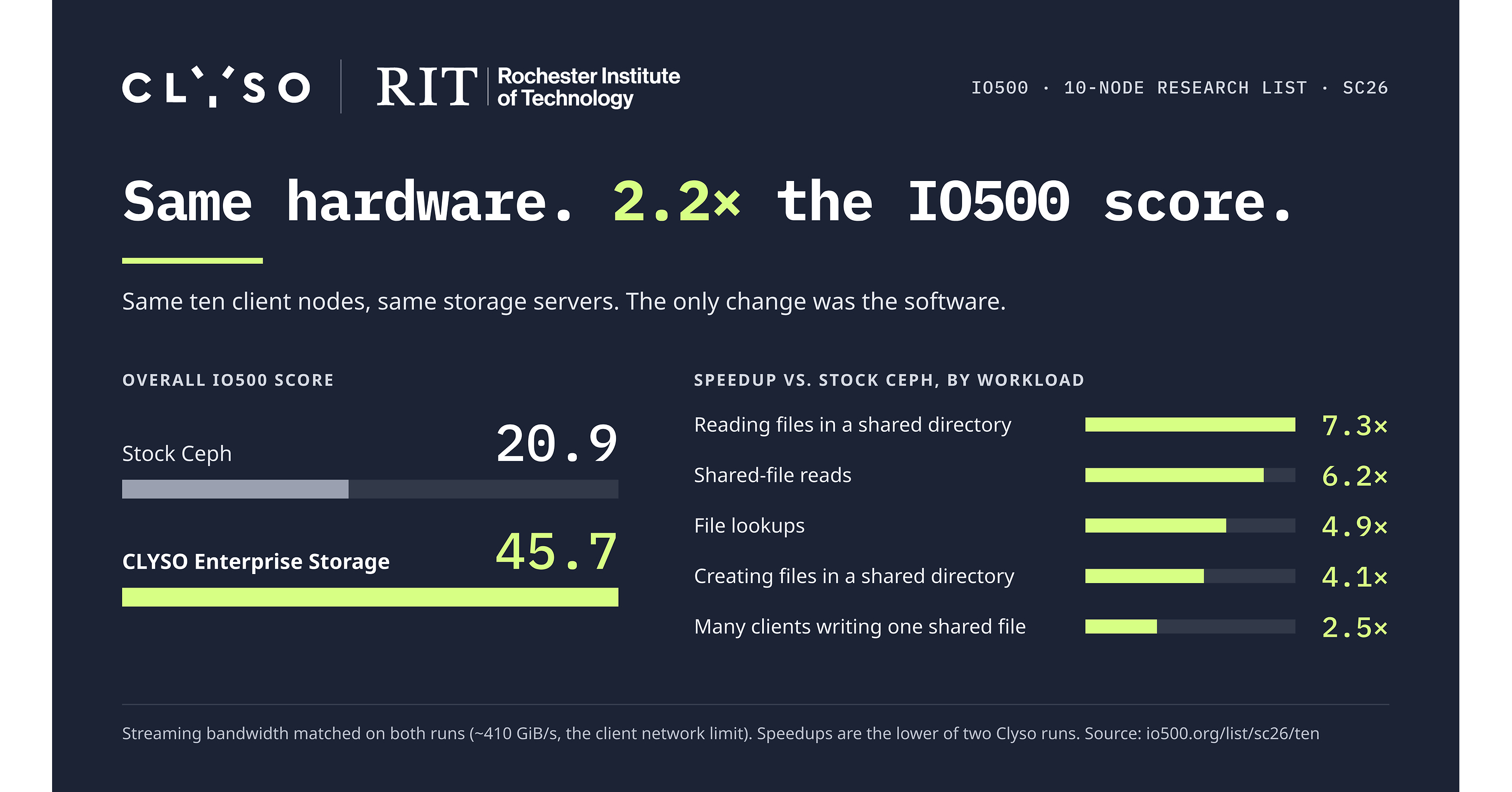
NEW YORK, Nov. 16, 2026 /PRNewswire/ -- Clyso, the Ceph engineering and support company, today announced that Rochester Institute of Technology (RIT) more than doubled its IO500 score with an early version of the next generation of CLYSO Enterprise Storage, on the same hardware. RIT ran the benchmark twice from the same ten client nodes against the same storage servers, one on stock Ceph and one on the new CLYSO Enterprise Storage. The score rose from 20.9 to 45.7, 2.2 times higher, and the biggest gains came where AI and HPC jobs hurt most: many clients working on the same files and directories at once.
IO500's 10-Node benchmark measures storage performance using a fixed set of ten compute nodes, providing a consistent comparison regardless of the underlying storage system's size. RIT's results go a step further: both tests used identical compute and storage hardware, with software as the only variable, demonstrating the performance gains delivered by CLYSO Enterprise Storage.
Most storage looks fast when every client works on its own files. Real training and simulation jobs don't work that way. Data loaders open millions of small files in shared directories, and hundreds of ranks write the same checkpoint at the same moment. When the metadata layer stalls, the GPUs wait. RIT's results show that Ceph, built and tuned by Clyso, eliminates critical storage bottlenecks delivering greater performance from existing hardware without additional infrastructure investment.
"We've seen measurable improvements to CephFS through our work with Clyso, particularly for AI and HPC workloads where shared-file access and metadata performance matter. We're pleased with the results so far and look forward to continuing to improve performance together," said Paul Mezzanini, Platform Engineer III at RIT.
Each figure is the lower of two Clyso…
One…
Opening of the article, excerpted from PR Newswire. To read the rest, open the article on the publisher's site.
MarketNews shows the headline and summary published by the outlet. The full article is on the publisher's website. (www.prnewswire.com)

