Two Americans, two journeys, but how many roads?
ملخص مفصل
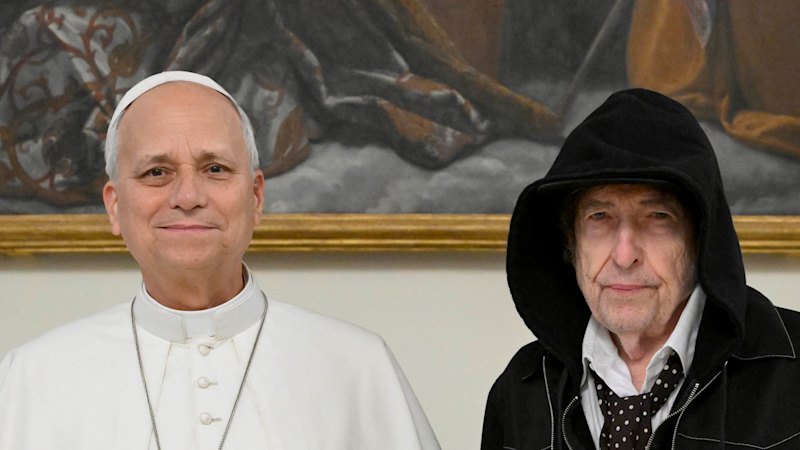
Pope Leo and music legend and Nobel laureate Bob Dylan met recently in a union of spirit.
Two shepherds met recently. One wore white, the other black. They both carried their faith with them to the meeting; the one in white conspicuously so, the other beneath the hood. Their meeting made news worldwide, for one was Pope Leo and the other was Bob Dylan, songwriter legend and Nobel laureate. Shepherds both, but with different flocks, and with different meanings to the description.
Pope Leo tends a global flock of more than a billion followers of the Catholic Church. Dylan’s flock cannot be quantified, and nor would he consider himself as tending it, but in many of his followers there is an unbreakable thread of devotion. His music has tested that strand over the course of a career of almost 70 years. But to paraphrase the man himself, he’s an artist, he don’t look back. One of those followers, as it happens, in a sort of divine coincidence, is the Pope, also from the American Midwest, the former from Chicago, the latter from Duluth.
Pope Leo quoted Dylan’s lyric in the preface to a book entitled Disarmed and Disarming: Peace Is a Gift, published by the Vatican Publishing House. The words weren’t from one of Dylan’s universally known songs such as Blowin’ in the Wind, but from an ultra-obscure one from 1963 that was never released. The song was Go Away You Bomb, the lyric the Pope quoted, “I hate you cause yer man-made and man-owned, an’ man-handled.” Some may say, it was easy to see why it never saw the light of day.
At the recent meeting in the Apostolic Palace in Rome, the Pope gave Dylan a rosary, while Dylan gave the Pope a copy of his book Chronicles: Volume One.
Dylan’s trajectory towards the spiritual light began in the public eye in the half shadows and side streets of lyrical allusions in his early works in the 1960s, only for it to burst into flame in the late 1970s and early 1980s when his conversion to Christianity was recorded, literally, in the trilogy of albums Slow Train Coming, Saved and Shot of Love.
While the overt display of his faith has…
مطلع المقال، مقتطف من The Age. لقراءة المقال كاملًا، افتحه على موقع الناشر.
يعرض MarketNews العنوان والملخص كما نشرتهما الوسيلة الإعلامية. المقال الكامل متوفر على موقع الناشر. (www.theage.com.au)