Is this iconic black hole image accurate? New study delivers an independent result
Résumé détaillé
New results provide a fresh perspective on the iconic ring structure of the M87 black hole.
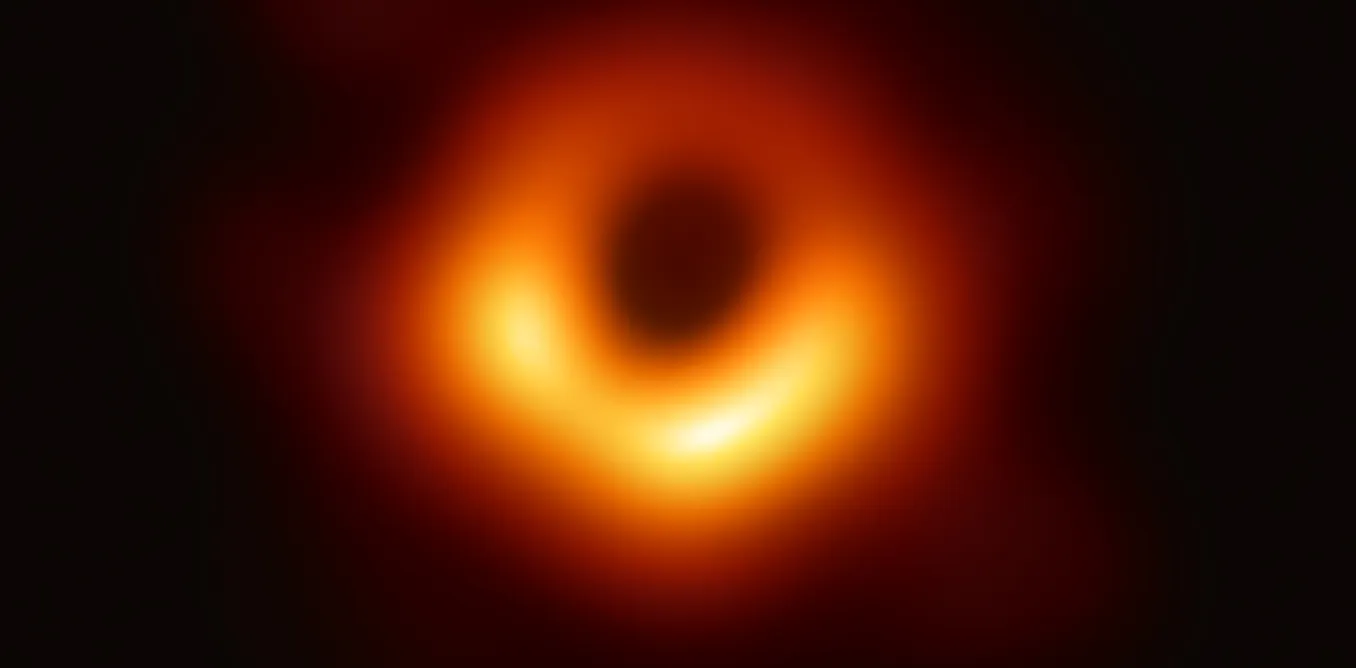
On April 10 2019, the Event Horizon Telescope (EHT) Collaboration revealed the first picture of a black hole. The object is at the centre of a galaxy known as M87, about 55 million light-years away.
The iconic ring structure instantly became one of the most recognised scientific images of the modern era.
It showed a black hole “shadow” outlined by light from swirling hot gas – just as predicted by Einstein’s theory of general relativity. The result supported the long-standing idea that the centres of galaxies house supermassive black holes.
However, scientists have since had some disagreements on whether the details and structure of the ring in the original publication were accurate.
Our new research, published today in Nature, used new techniques to investigate the original datasets. Not only do our results validate the original work, but they also provide a fresh perspective on the ring structure.
Our independent results enhance confidence in one of the most significant modern scientific results. And we bring the image of a black hole millions of light-years away back into focus.
Imaging the supermassive black hole at the centre of galaxy M87 is very challenging. It’s similar to photographing a doughnut on the Moon while standing on Earth. To obtain that level of sharpness and detail, you’d need a telescope the size of the entire planet.
To achieve this, the EHT combined signals from radio telescopes across the globe. Doing so enabled the sharpest imaging possible from down here on Earth. The results ushered in a new era of imaging – we could finally see the extreme environments around black holes.
Four independent imaging teams within the EHT Collaboration participated in the original publication. Though all teams produced a ring-like structure, there were some differences in how the black hole’s fine-scale features were represented. Such differences are known to be caused by human and algorithmic biases in the imaging process.
Début de l'article, extrait de The Conversation AU. Pour lire la suite, ouvrez l'article chez le média.
MarketNews présente le titre et le résumé publiés par le média. L'article complet se lit sur le site de l'éditeur. (theconversation.com)