ZTE Powers High Efficiency AIDC with Robust Energy Infrastructure
ملخص مفصل
SHENZHEN, China, Nov. 16, 2026 /PRNewswire/ -- As the AI wave surges forward, computing power is reshaping industries at an unprecedented pace. Yet behind every model training run…
SHENZHEN, China, Nov. 16, 2026 /PRNewswire/ -- As the AI wave surges forward, computing power is reshaping industries at an unprecedented pace. Yet behind every model training run and every inference call, what truly sustains continuous computing output is a stable, efficient, and green energy foundation. As per-rack power consumption climbs from 10–20 kW to 100 kW, 600 kW, and even 1 MW, as air cooling approaches its engineering limits and losses in traditional power supply links become increasingly prominent, the benchmark for AIDC competition is shifting from "computing scale" to "computing efficiency".
Computing Power Sprints Ahead, Electricity Becomes a "Scarce Resource"
Computing demand is growing explosively, and electricity consumption in computing centers is rising rapidly. The problem goes far beyond total electricity use: traditional data centers typically have a per-rack power consumption of 10–20 kW, while in the AIDC era, high-density deployment of GPU clusters has become the norm. Per-rack loads are quickly exceeding 100 kW, and high-end intelligent computing scenarios can reach 600 kW or even 1 MW.
The shortcomings of traditional power supply architectures are now exposed: significant losses occur across the multi-stage conversion chain from transformer to server, resulting in extra annual operating costs. Such architectures can no longer meet the needs of high-density racks, making power supply architecture innovation urgent. Cooling challenges are equally severe: the engineering limit of air cooling is approximately 20–30 kW per rack, beyond which cooling capacity drops sharply.
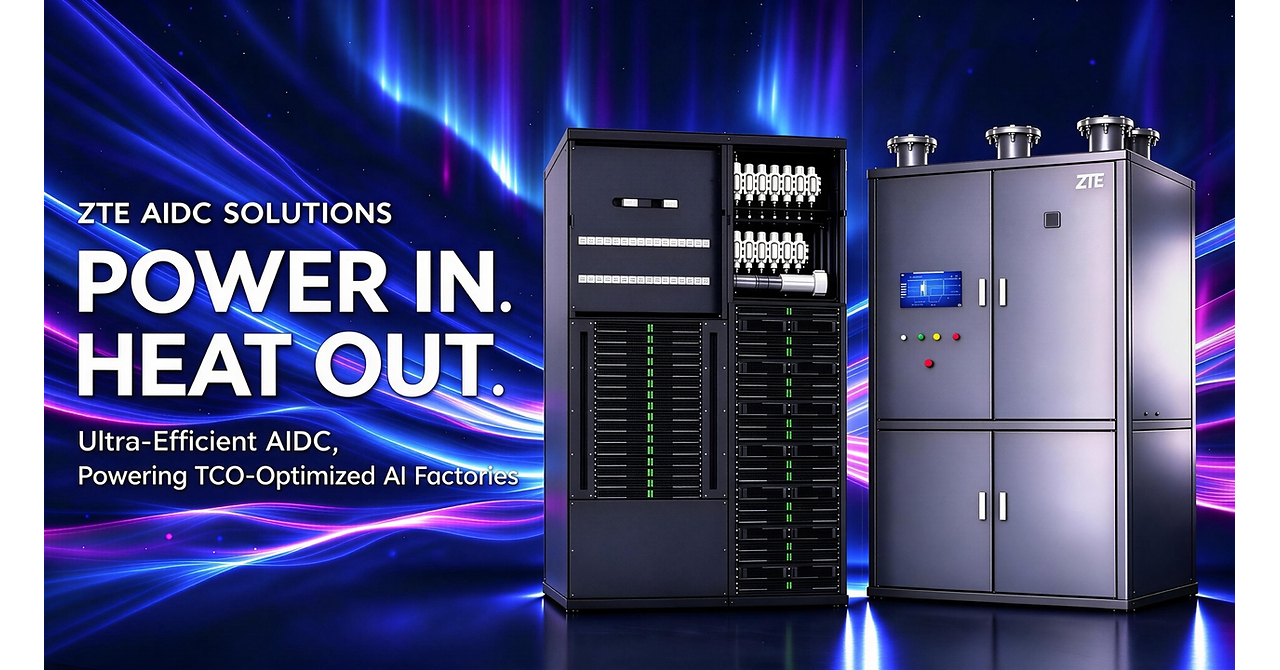
The competitive benchmark for AIDC is shifting from "computing scale" to "computing efficiency". The long-term development of AI computing power increasingly depends on the upper limit of energy supply and on the end-to-end conversion efficiency from Energy to Token. This is precisely the core proposition ZTE is addressing.
ZTE's first answer is the 800V high-voltage DC system…
مطلع المقال، مقتطف من PR Newswire. لقراءة المقال كاملًا، افتحه على موقع الناشر.
يعرض MarketNews العنوان والملخص كما نشرتهما الوسيلة الإعلامية. المقال الكامل متوفر على موقع الناشر. (www.prnewswire.com)

