Japan explores artificial blood for wounded soldiers at UAE military medicine congress
Résumé détaillé
Unlike conventional blood, haemoglobin vesicles require no blood-type matching and could be stored for longer storage, making them suitable for emergencies, disasters and military operations
What happens when a soldier is critically wounded on the battlefield but donated blood cannot reach them in time? Japan is exploring artificial red blood cells that could potentially bridge that gap, providing temporary oxygen-carrying support until a conventional blood transfusion becomes available.
The technology, known as haemoglobin vesicles, is being developed by researchers at Nara Medical University in Japan. It involves extracting haemoglobin, the oxygen-carrying protein found in red blood cells, and encapsulating it in tiny artificial structures called liposomes.
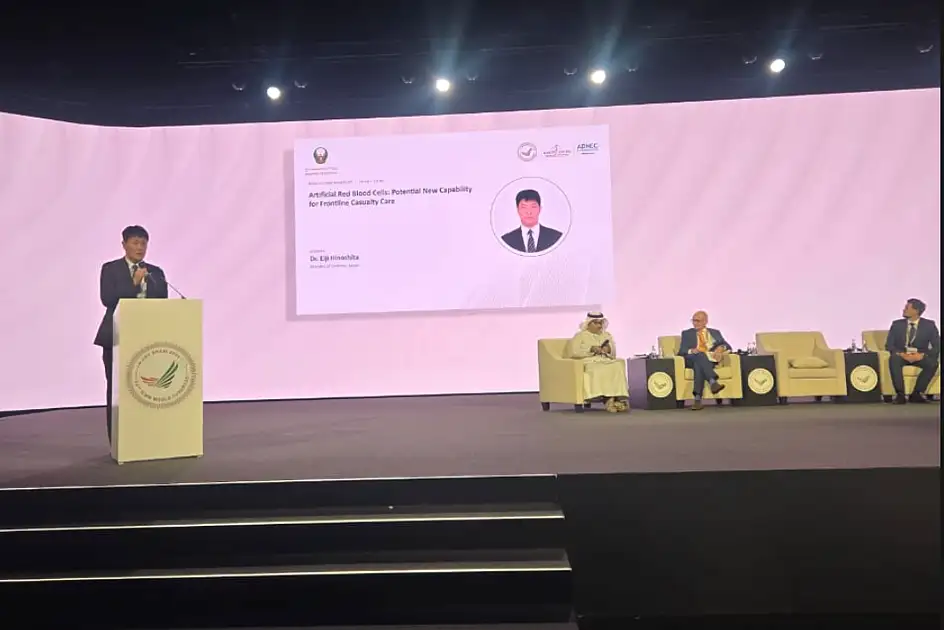
Presenting the research at the International Congress of Military Medicine in Abu Dhabi, Dr Eiji Hinoshita, director-general for health and medicine at Japan's Ministry of Defence, said conventional blood transfusions remained essential in combat casualty care, but transporting sufficient supplies to the point of injury could be difficult.
Logistical constraints, limited transportation and the conditions on the frontline can prevent blood from reaching severely wounded personnel quickly enough, creating a potentially fatal gap between injury and definitive treatment.
Japan is therefore looking at artificial blood as a possible additional capability, rather than a replacement for conventional donated blood.
The research was presented at the 46th World Congress of Military Medicine, which is being held at the ADNEC Centre in Abu Dhabi until November 13.
Organised in the UAE under the supervision of the International Committee of Military Medicine, the congress has brought together military medical professionals, researchers and defence health experts from more than 120 countries to discuss challenges ranging from battlefield trauma and emergency surgery to mental health and medical preparedness.
Unlike regular blood, the haemoglobin vesicles do not require blood-type matching. Their potential for longer-term storage could also make them suitable for stockpiling and use during military operations, disasters…
Début de l'article, extrait de Khaleej Times. Pour lire la suite, ouvrez l'article chez le média.
MarketNews présente le titre et le résumé publiés par le média. L'article complet se lit sur le site de l'éditeur. (www.khaleejtimes.com)