Endless voyage: How engineering ingenuity kept Voyager 1 alive for nearly five decades
Résumé détaillé
The Voyager spacecraft are the oldest operational deep-space probes that still actively communicate and share scientific data with Earth. Their main sources of ...
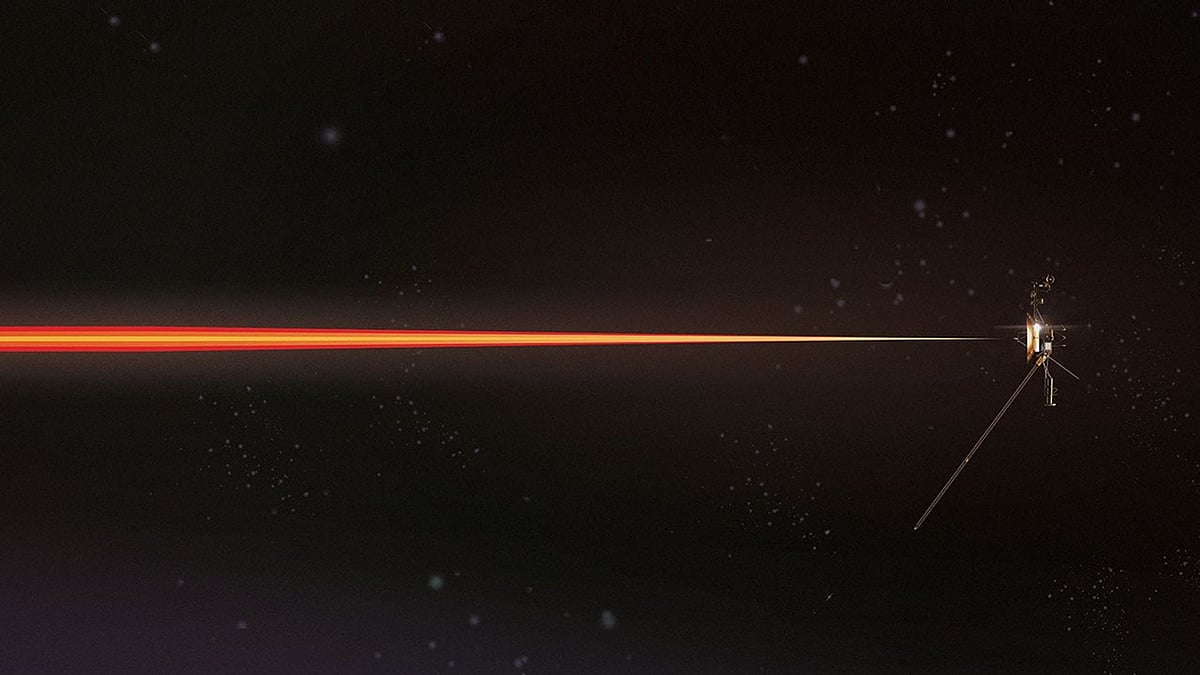
The Voyager spacecraft are the oldest operational deep-space probes that still actively communicate and share scientific data with Earth. Their main sources of power are three radioisotope thermoelectric generators (RTGs), that turn heat from decaying plutonium-238 into energy. This allows the spacecraft to operate far from the Sun, without solar panels. However, the generators produce less energy as time passes, and are currently losing about 4 watts a year, according to US space agency, NASA.
To save power, NASA has gradually switched off scientific equipment that are no longer essential or have declined in performance. Most recently in July 2026, NASA attempted a “Big Bang” fix — a first of its kind — with Voyager 2, by simultaneously turning off three high-power devices and turning on low-power ones to conserve nearly 10 watts a year and keep the spacecraft running. The team repeated the manoeuvre with Voyager 1 in September. Prior to this, NASA had switched off on both spacecraft equipment including the Low-Energy Charged Particles, cameras that comprise the Imaging Science Subsystem, and the Ultraviolet Spectrometer (UVS).
As of October 2026, the only active scientific instruments on both spacecraft are the Magnetometer and the Plasma Wave Subsystem. In addition, Voyager 2’s Cosmic Ray Subsystem, used to look for highly energetic particles from radiation fields of planets and from other stars, is still working.
In terms of communication, the Voyagers’ computers have very little memory in comparison to the technologies of today. They receive commands at 16 bits per second and send data back at 160 bits per second. Hence, engineers programme routine tasks, such as taking scientific measurements or checking an instrument’s calibration, to repeat at set intervals. The spacecraft can hence reuse instructions when needed.
Voyagers’ antennas must remain pointed towards Earth, or the signal can be lost.
This article was first published as part of the cover story "An…
Début de l'article, extrait de Down To Earth. Pour lire la suite, ouvrez l'article chez le média.
MarketNews présente le titre et le résumé publiés par le média. L'article complet se lit sur le site de l'éditeur. (www.downtoearth.org.in)